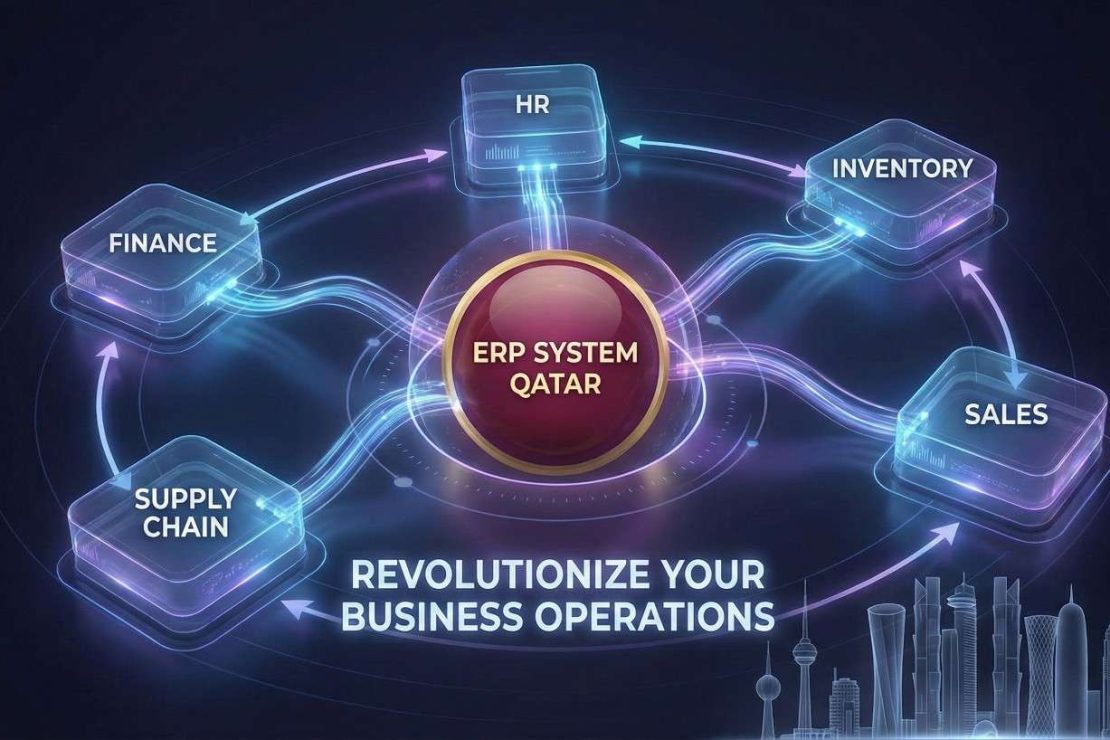
In the modern competitive and rapidly growing Qatari market, companies are on the permanent pressure to increase efficiency, optimize the processes, and keep in pace with the rapid digitalization. The possibility to make informed decisions and automatize the workflows is now more important than ever, regardless of whether a company is in retail, contracting, trading, manufacturing, or services. It is here that the ERP software Qatar enters the picture where centralized control, real time visibility, and operational accuracy of all business functions are offered. As Qatar continues to expand in the economic sector, the implementation of ERP solutions Qatar has the potential of changing the way organizations conduct their daily operations dramatically.
What Are ERP Solutions?
ERP (Enterprise Resource Planning) solutions are all-purpose systems that allow integrating all business processes, including finance, human resources, procurement, inventory, sales, and others, into one digital system. ERP enables businesses to operate in a single system, as opposed to using different tools or manual operation to control the company operations.
The Qatar version of modern Business ERP is developed to assist organizations to eliminate such common issues as data duplication, inaccurate reporting, manual errors, poor collaboration, and restrictions in inter-departmental visibility. ERP software also allows the organization to make decisions faster by linking all the departments in real time and providing the crucial business information that is constantly up to date and accurate.
The current trend in the ERP system is cloud-based which guarantees the ability to scale up, flexibility and its accessibility by the remote user who is planning on expanding his business in 2025 and beyond hence Qatari businesses. ERP offers an integrated online base whether a company requires enhanced financial oversight, computerized purchasing processes, enhanced personnel administration, or enhanced customer support.
Why ERP is important to the Qatar Business in 2025:
In the future of Qatar and its digital strategy and the national development, businesses should use smarter tools that can help them grow and remain competitive. ERP is particularly important to Qatari organizations in 2025 due to the following reasons:
-
Blistering Digital Change:
Firms in Qatar are hurrying towards digitizing their operations. ERP assists companies to automate their operations, cut down paperwork, and enhance teamwork. As the usage of cloud technologies continues to grow, business processes automation Qatar has taken the top priority.
-
Increasing Competitiveness in industries:
As the market embark on new entrants, companies will have to conduct their operations fast, accurate and efficiently. ERP is a guarantee of optimizing resource use, enhancing decision-making, and enhancing the customer experiences, without which it is impossible to be on the top.
-
Adherence to the Acts, Rules and Regulations, and Financial Accuracy:
The regulatory system in Qatar has compelled businesses to keep proper financial records, good tax documentation, and observe labor laws. ERP systems automate compliance reporting and are audit-ready.
-
Favoring Business Growth:
ERP offers scalability and flexibility as more and more companies grow or diversify. ERP can accommodate an addition of branches, products, or services in the business without any difficulty.
-
Improved Organizational Workforce.
It can be hard to in control employee data, payroll, leave requests and performance. HR and payroll ERP Qatar assists organizations to avoid mistakes, provide payments on time and enhance the satisfaction of employees.
-
Inventory/ Supply Chain Accuracy:
As the demand increases in trading and retailing, the organizations require accuracy in controlling the stock. Using best inventory management software, businesses are able to monitor stock movement, save on storage cost and prevent overstocking or stock out.
Basic Characteristics and modules that Modern Qatari Businesses are to seek include:
To select the appropriate ERP, one should know what features are the most influential. Although each business has specific needs, the following modules are required to functioning in the contemporary market of Qatar:
-
Financial Management:
An effective finance module comprises of general ledger, receivable/payable of accounts, budgetary, money flow tracking and automated reconciliation. It assists companies in closing books at a quicker rate and staying in compliance.
-
HR & Payroll Management:
This module will automate employee records, payroll, leave, attendance management, and performance evaluation. By using HR and payroll ERP Qatar, businesses can be sure of proper compensation in time and efficiency of the HR functions.
-
Inventory:
The company maintains an inventory of 20,000 products in its stock, categorized into five primary groups: parts, raw materials, semi-finished, complete parts, and finished goods.
Companies in which the goods or materials are involved have to monitor the stock immediately. Inventory management ERP Qatar is partly necessitated by such features like barcode tracking, stock forecasting, purchase planning, and warehouse automation.
-
Sales & CRM:
The sales teams become more visible of customer activity, order processing, sales pipeline, and customer communication. The automation of CRM guarantees better retention and sales forecasting of clients.
-
Vendor management:
An ERP will make it easier to purchase with automated approvals, supplier database, purchase orders, and contract management, which minimizes the delays and unauthorized purchases.
-
Project & Job Costing:
This module is ideal in contracting and service business and assists in real-time tracking of the budgets, schedules, project tasks, and profitability of a project.
-
Production Planning & manufacturing:
The work orders, the material planning, the production scheduling, and quality control constitute tools that can be of benefit to manufacturing firms.
-
Reporting:
The present-day ERP systems Qatar offer are dashboards and analytics that can be used to make better decisions due to the real-time tracking of the performance.
Who Gains the greatest: SMEs, Mid-Size Firms, and Enterprise?
ERP does not only belong to big corporations. Businesses of all sizes in Qatar can receive an advantage today:
-
Small and Medium Sized Businesses (SMEs):
ERP is most beneficial to SMEs because of low level of staff and manual processing. ERP helps them:
- Automate frequent tasks
- Improve cash flow
- Improve customer management.
- Eschew bottlenecks of operation.
In Qatar, SMEs have access to a variety of benefits with cloud-based Business ERP solutions, including low cost and easy implementation.
-
Mid-Size Companies:
With the growth of the middle-sized businesses, they need scalability and increased internal controls. ERP supports:
- Multi-branch operations
- Financial analytics Advanced.
- More effective workforce management.
- Efficient supply chain activities.
It forms base towards sustainable growth.
-
Large Enterprises:
Businesses have complex operations, numerous departments and have large volumes of transactions. ERP ensures:
- Real-time consolidation of data.
- Standardized processes
-
Multi-location and multi-currency management.
These organizations are also able to integrate ERP with other systems, as well as heavily customize it.
Best Practices:
-
Define Clear Objectives:
Prior to implementation of ERP, determine the overall objectives, i.e., automation of HR, minimization of inventory expenses or improved financial reporting. Configuration and customization is directed by clear objectives.
-
Choose the Right Vendor:
Choose a vendor that has good experience of the ERP software Qatar and understand the local business need, compliance need, and industry workflow.
-
Focus on User Training:
Employees are critical in the adoption of ERP. Make investments in training programs so that all the users can gain maximally out of the system.
-
Prioritize Data Migration:
Fix old data and make proper migration so that errors will be eliminated in the future. Good reporting means good quality of data.
-
Implement in Phases:
A slow implementation process minimizes the interference and allows every module to be implemented properly.
Common Pitfalls to Avoid:
-
Over-Customization:
Excessive customization complicates the system to operate. Use standard features unless it is absolutely necessary.
-
There is a tendency to underestimate Change Management:
Employees might not be willing to adopt automated workflow instead of the manual workflow. Speak timely, offer the best advice, and deal with anxieties.
-
Poor Project Planning:
Any omission of planning stages may cause delays and cost overruns. Appoint a special team and observe a systematized schedule.
-
Disregard of Post-Go-Live Support:
ERP needs constant updates, support and optimization. Make sure that your vendor has good post-implementation services.
Conclusion:
In a business world where competition, customer demands, and digital change are gaining momentum, ERP solutions Qatar are now necessary to ensure efficiency and be at the forefront. ERP offers a complete system to manage all the departments in a business whether an organization aims to streamline HR, streamline inventory, automate workflow, or carry out financial activities. Through embracing powerful Business ERP solutions Qatar, organizations would be able to develop real-time visibility, minimize expenses, increase productivity and expand comfortably in the year 2025 and beyond.
ERP is not an option anymore, it is a strategic requirement of the companies that want to modernize their business and create a more intelligent future.