
Introduction:
With organizations in Qatar getting increasingly modernized in their operations, the efficiency of people management has become as significant as finance or supply chain management. Having a multifaceted workforce and stringent labor laws, companies are shifting towards the digital solutions that extend beyond the traditional HR applications.
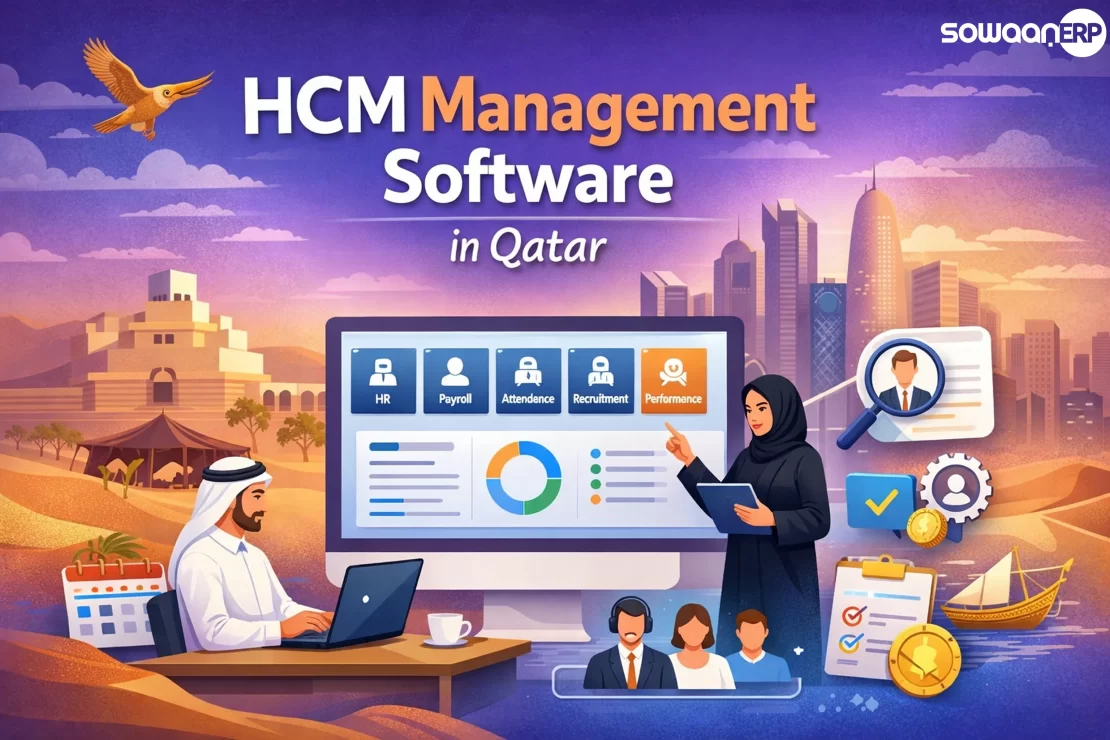
This is where HCM management Qatar solutions are being felt. The Human Capital Management software helps organizations to handle employees, payroll, compliance, and performance within a single integrated system. When incorporated into the accounting software in Qatar, HCM is a strategic part of the best ERP in Qatar, which assists the business to grow sustainably without breaching the rules.
What Is HCM Management?
Knowledge of Human Capital Management:
Human Capital Management (HCM) is an elaborate process of managing employees in the whole lifecycle of employment. HCM puts an emphasis on workforce planning, talent development, payroll accuracy and employee engagement unlike the simple HR systems that only concentrate on record keeping.
Under the conditions of HCM management Qatar, the companies apply HCM software to align HR operations to business goals and still remain compliant with the local labor laws.
The difference between HCM and the conventional HR systems is as follows:
The old HR systems primarily contain data on employees and record attendance or leave. HCM, in its turn, combines the core HR, payroll and HCM software Qatar, performance management, and analytics into one. This will enable the leadership teams to make informed decisions instead of using manual reports.
The importance of HCM Management to Qatari businesses can be explained in the following way:
Dealing with a Diverse Workforce:
Qatar has a diverse workforce with a representation of various countries and each has a different contract, benefits and payroll set ups. A central HR/payroll system used in Qatar will assure consistency and equity throughout the organization.
Adherence to Qatar Labor Laws:
Compliance is one of the largest HCM management benefits. HR & payroll software in Qatar systems can assist organizations with local labor laws and avoid sanctions by ensuring that they are in compliance with these laws, whether the rules involve contract management, calculation of the wage, or benefits at the end of the service.
Efficiency in the Payroll Process:
Any company conducting its activities in Qatar needs to have a powerful payroll management system. HCM software automates the calculation of payroll, deductions and approvals and avoids errors and employees are paid correctly and in time.
Improving the Employee Experience:
The current HCM systems incorporate employee self services where the employees can access their payslips, seek leaves and update their personal information without necessarily relying on the HR departments. This enhances transparency and satisfaction and minimizes the work of the administration.
HRIS vs HRMS vs HCM:
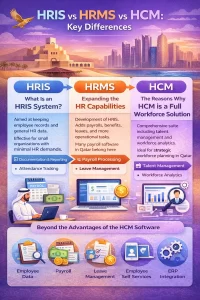
What Is an HRIS System?
An HRIS system is aimed at keeping the records of employees and general HR data. It is mainly applied in documentation, attendance and reporting. HRIS is effective in small organizations having minimal HR demands.
Expanding the HR Capabilities with the help of HRMS:
HRMS is a development of HRIS, and it incorporates operational tasks, including processing payrolls, benefits, and leaves. A high number of HR and payroll software in Qatar solutions belong to this category.
The reasons why HCM is a full Workforce Solution:
HCM encompasses all the features of HRIS and HRMS with the extension to talent management, performance assessment, and workforce analytics. In the case of a comparison between HCM vs HRIS, HCM is more appropriate to organizations that would like to grow long term and carry out strategic workforce planning.
Beyond the advantages of the HCM software, the software offers several features:
Basic HR and Statistical Data of the Employee:
HCM systems consolidate the records of employees, organizational structure, and job roles with the result that the data between and among departments is accurate and readily available.
Payroll and HCM Software Qatar Abilities:
One of the functions of HCM is payroll processing. The systems facilitate payroll ease and reliability through offering salary frameworks, allowances, deductions, overtime and adherence to Qatar laws.
Integration of Leave Management System:
A digital leave management system will enable an employee to post leave requests as a manager approves the requests in real time. This guarantees compliance to policy and better planning of work force.
Employee Self Services and Transparency:
Employees through employee self services will have direct access to their HR information. This will minimize reliance on the HR departments and brings out a more open working environment.
Qatar Accounting ERP Integration.
In Qatar, HCM software can be used to work with accounting ERP enabling the HR and finance departments to cooperate with the same data. It is one of the characteristics of the best ERP Qatar solutions.
The comparison made between Cloud-Based and On-Premise HCM Systems in Qatar is as follows:
Cloud-Based HCM Systems:
The HCM solutions on the cloud are available anywhere and online. They suit best those businesses that require flexibility, scalability, and reduced costs in infrastructure.
Payroll and HCM software Qatar is particularly one of the most popular deployments to the Cloud, as it is guaranteed to be updated automatically and allows being managed easier in terms of compliance.
On-Premise HCM Systems:
Premise systems are placed on-site and operated within the organization. Although they provide increased control, they demand increased initial investment and dedicated IT resources. Very large organizations having stringent data policies can still be interested in this model.
Selection of the appropriate HCM Software:
Software-Business Need Fit:
The initial process in choosing HCM software will be to know the size of your organization, labor setup, and future expansion.
Payroll and Compliance Accuracy:
It is essential to have a dependable understand payroll administration framework. Companies ought to make sure that the software is compatible with Qatar labor and payroll.
The evaluation of Integration and Scalability:
HCM software must be compatible with the accounting ERP in Qatar and be able to be expanded as the organization increases, which guarantees long-term value.
Vendor Support and Localization:
Selecting a local vendor will be more successful in terms of implementation, training, and continuing support in accordance with the business environment of Qatar.
Prospects of HCM Management in Qatar:
HR Transformation into the Digital Age:
With Qatar moving towards a knowledge-based economy, the HCM systems will keep on becoming intelligent workforce platforms.
Application to HCM: AIs and analytics:
Advanced analytics will assist companies to predict the workforce requirements, enhance retention, and enhance performance.
HCM as a component of the Best ERP in Qatar:
HCM will be more of an embedded module of ERP systems that will be more significant in strategic planning and business intelligence.
Conclusion:
HCM management has ceased to be a luxury to businesses in Qatar but rather a necessity. Compliance and payroll automation, employee engagement and strategic planning of workforce are only some of the solutions offered by HCM management Qatar that allow organizations to work efficiently and competitively.
The businesses will be able to create a future-ready workforce by selecting the appropriate HR and payroll software in Qatar and integrating it with accounting ERP in Qatar and by prioritizing scalability. Finally, the modernization of HCM solutions is one of the primary steps to the implementation of the most appropriate ERP in Qatar and the achievement of success in the long run.
FAQ SECTION:
Q1. What is the HCM management in Qatar?
HCM management in Qatar means application of Human Capital Management software in order to coordinate the entire cycle of employee management in line with the local business and labour needs. It offers both basic HR services (employee records, attendance, payroll and leave) and more sophisticated services (performance management, talent development and workforce analytics). Other issues addressed by HCM management in Qatar include complying with the labor laws, managing the diverse workforces, and integrating HR operations with the accounting system and the ERP system in order to make better decisions.
Q2. Is HCM software in line with the Qatar labor law?
Yes, the majority of HCM software solutions available and utilized in the Qatar are aimed at compliance with Qatar Labor Law. Such systems assist companies in keeping control over working times, overtime, leaves, calculations of payrolls and final benefits. An adhered HCM platform also means good documentation, appropriateness of contracts and clear payroll processing. Nevertheless, companies are always advised to prefer HCM software localized to Qatar and constantly modified because of regulatory changes.
Q3. What is the distinction between HCM and HRMS?
The key distinction that exists between HCM and HRMS is the extent and purpose. HRMS is mainly concerned with the operational Hr activities like payroll, attendance, and leaves. HCM, in its turn, is more strategic and broader because it encompasses the whole lifecycle of the employees. HCM also encompasses all HRMS capabilities and then incorporates talent management, performance appraisal, learning and development, workforce analytics, and is therefore more appropriate in organizations that are interested in long-term expansion and workforce optimization.
Q4. What is the most appropriate HCM software?
The optimal HCM software is based on the size of business, industry, and operational needs. The best HCM solution in Qatar is one that is legal in accordance with the local labor legislations, has good payroll features, self-service of employees and one that is compatible with the accounting and ERP systems. Scalability, cloud availability, and local support also need to be looked at by the businesses when selecting an HCM platform to make sure that it matches their immediate requirements and overarching expansion in the future.
