
Introduction:
Human resource management in Qatar is currently changing at a very high rate since organizations have been changing towards digital transformation, policies of workforce localization, and increased compliance needs. Between small and the large organization, companies are abandoning manual HR systems and spreadsheets in favor of an organized digital system. This change has brought the HR technology to be a strategic need as opposed to another support service.
The Human Resource information system (HRIS) remains one of the most used solutions in this transformation. The companies seeking the answer to what is HRIS in Qatar are usually seeking having a workable system that can enhance data relating to employees, payroll coordination, HR automation, and compliance through a single platform. HRIS is an essential part of the contemporary HR functioning because Qatar is a competitive market where efficiency and accuracy are essential.
This blog discusses the concept of HRIS, its applications, advantages and how companies in Qatar could select the appropriate HRIS to help them grow in the long run.
What is HRIS:
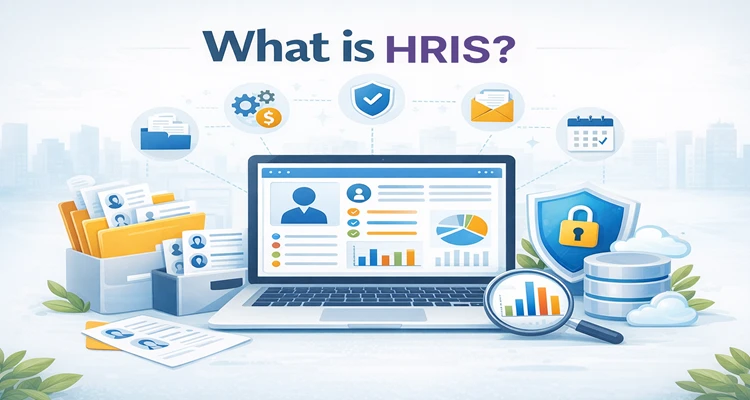
HRIS or Human Resource Information System is an electronic tool, which exists to handle, keep, and handle employee-related data in an organization. Its fundamental functionality is that HRIS serves as a central database on employee data, such as personal information, work history, timecard information, payroll information and performance information.
To Qatar-based businesses, HRIS is not just a simple data storage tool. It aids in adherence to the local labor laws, coordination of payrolls and is compatible with HR and payroll software to maintain accuracy and transparency. The HRIS is the core of the HR ecosystem in many companies that are engaged in HR software across the Qatar.
Unlike manual systems, HRIS offers real time access to data, automated workflows and report structure. This enables the HR to concentrate on strategic activities and not in administration which is repetitive.
Uses of HRIS:
HRIS is applied in various HR activities, which makes it a crucial instrument to organizations of any size. Employee data management is one of its best applications where the HR departments can keep accurate and current records in a safe place.
The next important HRIS application is payroll coordination. HRIS is useful when combined with HR and payroll software to make sure that salaries, allowances, deductions, and overtime are computed properly. This can be particularly useful to companies providing employment to varied personnel in Qatar.
other functions of HRIS are attendance tracking, leave management, onboarding, and offboarding. Under HR automation, monotonous processes like leave approvals, policy recognitions, etc. are completed quickly and uniformly. Also, several HRIS systems are compatible with ERP and already-in-use accounting software used by Qatar businesses, which results in a smooth transfer of information between departments.
HRIS vs HRMS vs HCM:
Knowledge on the difference between HRIS, HRMS and HCM is essential in HR software selection in Qatar.
The HRIS is mainly aimed at employee information and HR core management. It is data-focused and is suitable to the companies that desire to have structured record-keeping and compliance assistance.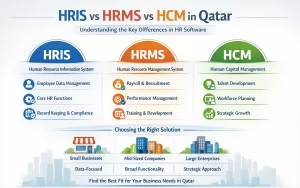
The Human Resource Management System, which is also called HRMS, builds on HRIS, and adds payroll, recruitment, performance management, and training modules. HRMS is frequently favored as it has a wider range of functionality than businesses seeking the Best HR software for small business Qatar.
HCM or Human Capital Management is strategic in its approach in that it concentrates on workforce planning, talent development and long-term employee value. The HCM management Qatar solutions are usually applied in large enterprises that emphasize on analytics and workforce optimization.
Although comparisons between HRIS and HRMS point out the difference in scope, several of the modern HR technologies have merged the features of all three systems to provide flexible solutions depending on the needs of the businesses.
Benefits of HRIS:
The introduction of HRIS provides quantifiable organizational benefits in Qatar. Among the greatest benefits, better efficiency due to HR automation should be highlighted. Paperwork and manual data entry are minimized and help to save time and carry out fewer errors.
Data accuracy and data security is also improved by HRIS. The information about the employees is kept in a central database and with limited access to the data center, the information in the database remains unaffected. This is especially significant to adhere to the labor laws.
The other advantage is that better decisions are made. The HRIS capabilities consist of reporting and analytics which present workforce trends, absenteeism and payroll expenditure. Combined with ERP and accounting software that the Qatar companies are dependent on, HR leaders will see the entire picture of business activities.
Moreover, HRIS enhances the experience of employees with self-service portals allowing them to request leaves and access payslips and update personal data.
Types of HRIS Systems:
Various forms of HRIS systems exist in the market with each system addressing the needs of different organizations.
Operational HRIS is concentrated on day to day HR functions which include employee records, payroll organization and attendance. Small and medium-sized businesses usually employ this type.
Tactical HRIS, aids in the recruitment, training, and performance management. It assists the HR teams in the planning and running of the workforce development programs.
Strategic HRIS pays focus on strategic planning, analytics, and talent management. This model is frequently used in organizations that are seeking to align their HR strategy with their business growth.
Most of the current HRIS systems are also connected to other systems like inventory management software that Qatar businesses would be using to ensure that the cross-functional collaboration is well coordinated.
The right choice of HRIS to your Qatar Business:
The choice of the appropriate HRIS involves a proper consideration of the business needs and future objectives. Organizations are supposed to begin by evaluating the existing HR problems that can be inaccuracy in payroll, compliance problems or absence of automation.
Another important feature is scalability. The system implemented must facilitate the development of business and meet the evolving demands of the workforce. The integration features are also crucial, and particularly to the companies that have already installed ERP and accounting software Qatar-based operations rely on.
It should also be easy to use, locally compliant and reliable with its vendors. The attraction of many businesses in Qatar to the best ERP would favour those that include HRIS within their wider ERP features to manage in a single unit.
Future of HRIS:
The future of HRIS in Qatar is related directly to the digital transformation and new HR technology. The next generation of human resource systems is determined by cloud-based tools, artificial intelligence-driven analytics, and highly automated systems.
HRIS will become more relevant in predictive workforce, real-time performance and integrate further with the business systems. Since HR software Qatar is constantly changing, HRIS will still guarantee the foundation of efficient and compliant HR functions.
Conclusion:
Learning about the nature of HRIS in Qatar will enable the businesses to make wise choices regarding HR digitalization. HRIS is not a data management system; it is a strategic system that enhances efficiency, accuracy, and engagement of the employees.
Through the proper adoption of HRIS, organizations will be able to streamline HR work processes, bring together their payroll and accounting services, and be in a position to grow going forward. HRIS is a critical element of the present-day business in a competitive market.
